
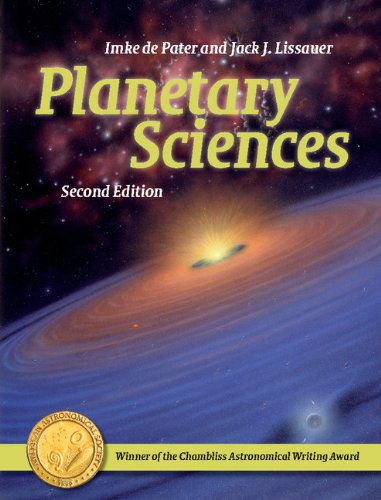
Planetary sciences /
Material type: TextPublication details: New York : Cambridge University Press, 2010.Edition: 2nd edDescription: xvi, 647 p., [24] p. of plates : illISBN:
 - 9780521853712 (hardback)
- 0521853710 (hardback)
- MED QB601 .D38
| Item type | Current library | Call number | Status | Barcode | |
|---|---|---|---|---|---|
 Books
Books
|
Directorate of Library Services General Collection | MED QB601.D38 (Browse shelf(Opens below)) | Available | 0000000229089 |
Machine generated contents note: Preface; 1. Introduction; 2. Dynamics; 3. Solar heating and energy transport; 4. Planetary atmospheres; 5. Planetary surfaces; 6. Planetary interiors; 7. Magnetic fields and plasmas; 8. Meteorites; 9. Minor planets; 10. Comets; 11. Planetary rings; 12. Extrasolar planets; 13. Planet formation; Appendices; References; Index.
"An authoritative introduction for graduate students in the physical sciences, this textbook explains the wide variety of physical, chemical, and geological processes that govern the motions and properties of planets. The second edition of this awarding-winning textbook has been substantially updated and improved. It now contains a reorganized discussion of small bodies, including a detailed description of the Kuiper belt and asteroid belt; a significantly expanded chapter on extrasolar planets and what they tell us about planetary systems; and appendixes providing a glossary of acronyms, tables of key spacecraft, a summary of observing techniques, and a sampling of very recent images. With over 300 exercises to help students apply the concepts covered, this textbook is ideal for courses in astronomy, planetary science and earth science, and well suited as a reference for researchers. Color versions of many figures and movie clips supplementing the text are available at www.cambridge.org/9780521853712"--Provided by publisher.
"An authoritative introduction for graduate students in the physical sciences, this textbook explains the wide variety of physical, chemical, and geological processes that govern the motions and properties of planets. The second edition of this awarding-winning textbook has been substantially updated and improved. It now contains a reorganized discussion of small bodies, including a detailed description of the Kuiper belt and asteroid belt; a significantly expanded chapter on extrasolar planets and what they tell us about planetary systems; and appendixes providing a glossary of acronyms, tables of key spacecrafts, a summary of observing techniques, and a sampling of very recent images. With over 300 exercises to help students apply the concepts covered, this textbook is ideal for courses in astronomy, planetary science and earth science, and well suited as a reference for researchers"--Provided by publisher.
There are no comments on this title.